Fugitive status
Kay ScarpettaFugitive status becomes the decisive condition governing Oscar Bane’s place in the investigation. Once physical evidence connects him to Eva Peebles’s apartment and he disappears instead of surrendering, the authorities treat him not merely as a suspect but as a fugitive from justice. Yet the flight is inseparable from his persecutory beliefs: the same conduct that appears incriminating to the police appears, to Benton Wesley, psychologically consistent with a man convinced that he is being watched and hunted.
Causes and Background
The suspicion surrounding Oscar begins with evidence at Eva Peebles’s apartment. Shoeprints on the bathroom toilet lid exactly match the shoes Oscar was wearing when, according to his account, he discovered Terri Bridges’s body. More damaging still are Oscar’s fingerprints on a glass lamp that the killer had removed from the ceiling and placed in the bathtub. The combination gives investigators a concrete physical link between Oscar and a second crime scene, even though his earlier claim was that he had found Terri’s body rather than killed her.
That evidence arrives within a larger atmosphere of uncertainty. Oscar has already been treated at Bellevue, and his behavior is read through the language of paranoia and persecution. Benton argues that Oscar would not be persuaded that surrender was safer because he is extremely paranoid; nothing, in Benton’s assessment, can overcome Oscar’s conviction that he is being followed and spied upon. Fugitive status therefore has two simultaneous meanings. Legally, it marks Oscar as someone evading arrest. Psychologically, it is also the outward form taken by his belief that capture would place him in the hands of an enemy.
The Manhunt
Shortly after midnight, an arrest warrant is issued for Oscar. Police circulate an appeal for information by radio and over the internet, and Mike Morales alerts Interpol in case Oscar has managed to pass airport security and customs and leave the country. The search rapidly acquires a national scale. News reports replace the label of “dwarf killer” with “dwarf monster,” while reports that Oscar has been seen produce a climate of fear in which some little people, particularly young men, remain at home because they fear aggression or something worse.
The public language surrounding the search is itself consequential. Before guilt has been established in court, Oscar is converted from a person under suspicion into a monstrous media image. The widening hunt protects the investigation’s reach, but it also magnifies the social danger attached to his body and identity. Fugitive status thus operates not only as a police classification but as a public narrative that encourages fear, simplifies ambiguity, and makes Oscar’s eventual treatment appear predetermined.
Flight and Investigation
Marino insists that Oscar’s disappearance is especially incriminating because Oscar knows the police are looking for him and has chosen to run. In Marino’s view, surrender would be both better and safer for Oscar. Benton rejects that reasoning, not because he has cleared Oscar, but because Oscar’s mental condition changes the meaning of flight. A person who believes surveillance is already underway may regard every official contact as a trap and every appeal to surrender as proof that the persecutors have found him again.
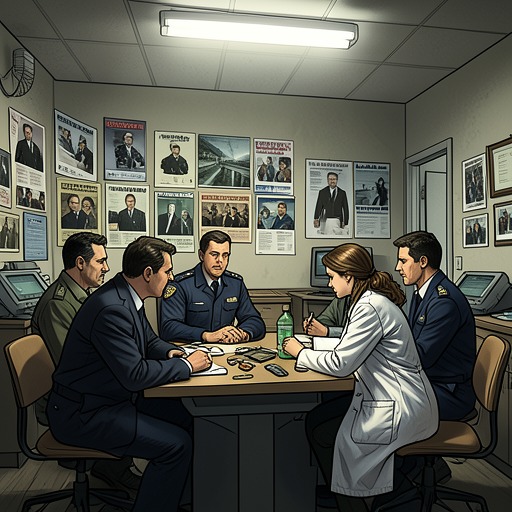
The investigators consequently debate how to reach him without confirming his fears. Benton reasons that Oscar will not listen to voicemail because he is unlikely to risk putting the enemy back on his radar. The only person Oscar apparently trusted and considered important is dead, and Benton is uncertain whether Oscar still trusts Kay Scarpetta. Morales proposes an email sent from the scarpetta612 account, because Oscar believes Scarpetta is its author. The proposed appeal would exploit Oscar’s trust while also making Scarpetta bait in an attempt to bring him back into police custody.
That strategy exposes the moral pressure created by fugitive status. Lucy Farinelli understands that Oscar is officially wanted and would probably be charged and convicted if captured, but she does not want to think about what would await him in prison. Scarpetta is likewise reluctant to become the lure. The investigation must protect the public and preserve evidence, yet its chosen method risks using the very relationship that may offer Oscar his last remaining link to reality.
Competing Explanations
The fugitive label does not settle the question of who committed the murders. The fingerprints and matching footwear make Oscar’s disappearance dangerous evidence against him, but the case continues to contain contradictory clues and alternative suspects. The investigators identify a connection between Eva and the anonymous Gotham Gotcha operation above Terri Bridges’s apartment: the upstairs residence is leased in the name of Cesare Ingicco, an Italian financial figure whose company is based on the Isle of Man, while rent is paid by an offshore firm. Marino suspects that the named tenant does not actually live there and that another person may be working from the apartment.
Lucy’s technical investigation reveals an anonymous IP address for the Gotham Gotcha columnist and an internet-provider account registered to a limited-liability company on the Isle of Man. Its jurisdictional privacy protections make it difficult to identify the firm’s owners. The machine-access code does not match any known laptop or other device, and the columns were not sent from any email accounts the investigators have found. Lucy also traces payments sent from England to Eva on Gotham Gotcha’s behalf and works with a former ATF contact in the tax authorities to obtain financial information. These details preserve a second line of inquiry even as Oscar’s fugitive status dominates the immediate response.
Legal and Psychological Consequences
Oscar’s disappearance changes the practical balance of the case. He is no longer simply available for psychiatric observation or questioning; he becomes an active target whose movements must be anticipated, whose communications may be monitored, and whose possible escape requires international coordination. The police must act quickly, while the investigators must distinguish behavior caused by fear from behavior intended to conceal guilt.
The same ambiguity appears elsewhere in the book. Benton Wesley speaks publicly from a television studio, identified as a forensic psychologist associated with McLean Hospital and formerly head of the FBI behavioral-sciences division at Quantico. He states that the urgent purpose of his appearance is to ask Oscar to contact the FBI. The broadcast is an attempt to turn public communication into a controlled channel of surrender, but Marino views Benton’s decision to go live internationally as a dangerous improvisation. The fugitive is therefore pursued through both institutional force and psychological appeal.
Fugitive status finally functions as a state of suspended identity. Oscar is accused, hunted, and publicly demonized, but the investigation has not fully resolved whether he is a murderer, a witness trapped by circumstance, or a persecuted man whose flight confirms the fears of those pursuing him. His refusal to surrender is legally damaging and psychologically intelligible at the same time. That double reading sustains the novel’s central tension: the machinery designed to find a dangerous person may also intensify the conditions that make him run.